
Buyer guide
Cobot vs Industrial Robot Welding: Which Is Right for Your Shop?
RA Machine · Updated
What is the difference between a cobot and an industrial welding robot?
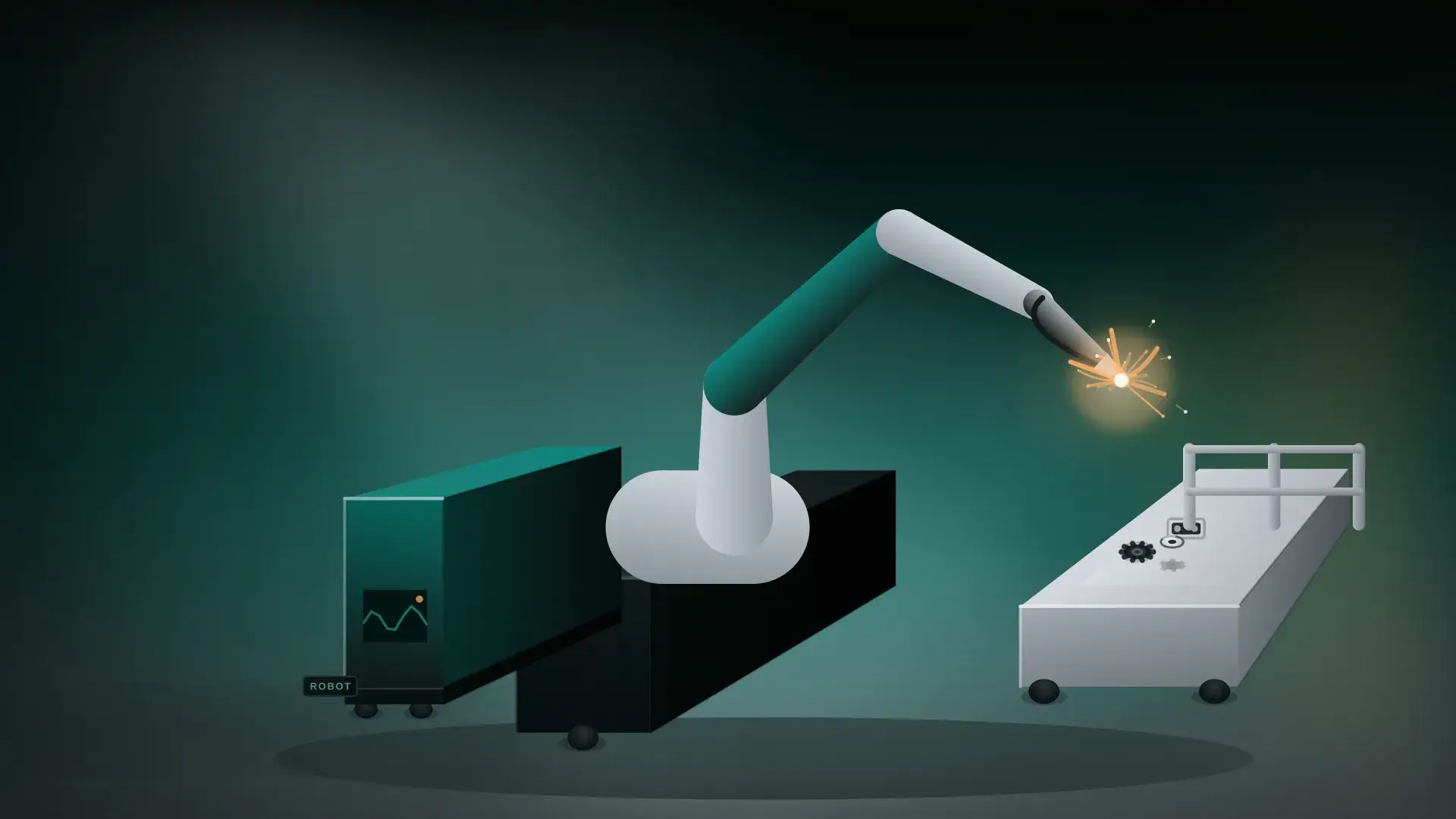
Both carry a welding torch on a programmable arm and repeat a taught path with the same speed, angle and distance every time. The difference lies in how they are built to work around people. A collaborative robot, or cobot, is designed to share a workspace with an operator. It limits its own speed and force and stops when it senses an unexpected contact, so with the right risk assessment it can work without a full fenced cell.
An industrial robot is built for speed, rigidity and endurance. It moves faster, carries heavier torches and accessories, and is designed to run shift after shift. Because of that speed and force, it must work inside a guarded cell with interlocked doors, light curtains or area scanners that stop it when someone enters. In welding, both are usually set up for MIG/MAG, and both depend on the same power source, wire feeder and good fixtures.
How do safety and floor space compare?
A cobot's built-in force and speed limits are its main attraction for many shops. It can sit at a bench or a welding table, with the operator loading the next part nearby. That does not mean it needs no protection. A welding cobot still produces an open arc, spatter and fume, so screening against arc light and fume extraction are needed, and the whole application, including sharp parts and the torch itself, must pass a risk assessment before people work alongside it.
An industrial robot needs more space for its fencing, and the layout has to allow safe access for loading and maintenance. In return the cell contains arc light, spatter and fume well, and it can be laid out with two stations so the operator loads one while the robot welds the other. Where floor space is tight, the smaller footprint of a cobot can decide the matter on its own.
How are they programmed, and how fast is changeover?
Most welding cobots are taught by hand. The programmer moves the arm and torch to each point of the weld, saves the position on a tablet or teach button, and sets the weld parameters. For simple parts this can be done in a short time by someone who knows welding but has never programmed a robot. That makes cobots well suited to shops that make many different parts in modest quantities.
Industrial robots are usually programmed with a teach pendant, and often with offline programming software that builds the path from a 3D model. Programming takes more training, but the resulting programs run faster and can handle complex multi-axis paths and coordinated positioners. Once set up for a part that runs for months, the extra programming effort is repaid many times over.
Which gives better speed, output and weld quality?
On weld quality alone the two are closer than many buyers expect. The weld is made by the power source and wire feeder, and both types of robot hold the torch steadily. The difference shows in cycle time. An industrial robot moves between welds much faster, can handle heavier torch packages and larger reach, and is better integrated with positioners that turn the part for the best welding position. Over a full shift on high-volume work, that adds up to significantly more parts.
A cobot's slower travel between welds matters less when batches are small, because more of the day is spent loading, changing over and checking parts. For many shops the honest comparison is not cobot against robot, but either of them against the variable output of manual welders.
Cost follows the same pattern. The arm itself is only part of the investment. The welding package, torch, fixtures, any positioner, guarding, fume extraction, installation and training all add to it. A cobot usually needs simpler guarding and integration, which keeps the overall project smaller. An industrial cell costs more to set up but spreads that cost over many more parts when volumes are high.
Cobot or industrial robot: how to decide
Look at your parts, batch sizes and floor space before looking at the robot. These rules of thumb cover most fabrication shops.
- Many different parts in small or medium batches, with frequent changeovers: cobot
- First step into automated welding, with no in-house robot programmer: cobot
- Tight floor space and parts that can be loaded at a table: cobot
- High volumes of the same parts, running across shifts: industrial robot
- Large or heavy assemblies that need positioners and long reach: industrial robot
- Tight cycle times where seconds per part affect delivery: industrial robot
Is your work ready for robotic welding?
Whichever you choose, a robot welds exactly where it was taught. It cannot see that a part was cut short or that a gap has opened up, the way a manual welder would. Consistent parts are therefore the first requirement. Blanks from CNC laser or plasma cutting, accurate bending and well-designed fixtures that locate every part in the same place are what make robotic welding reliable.
People matter too. Loading parts and starting a saved program can be done by an operator without welding qualifications, but programming and setting parameters is best done by someone who understands welding. Many shops retrain an experienced welder for this role. Routine care, such as changing contact tips and nozzles, cleaning the torch and checking cables and liners, should be built into each shift.
How RA Machine configures robotic welding systems
RA Machine supplies both cobot and industrial robot welding systems, configured to the buyer's requirement. There is no fixed model list: we look at your parts, drawings, quantities and floor space, then recommend the type of robot, the welding package, fixtures and any positioner the work needs, and explain why.
Installation, commissioning, and operator and programmer training are included, and safety systems are tested before handover. Support includes remote diagnostics within four working hours, on-site service the next working day around Kolkata and within 48 hours elsewhere in India, stocked spares and a 12-month warranty, with customised extended warranty on request. Typical lead time is 8 to 10 weeks.
Our range
Machines for this job
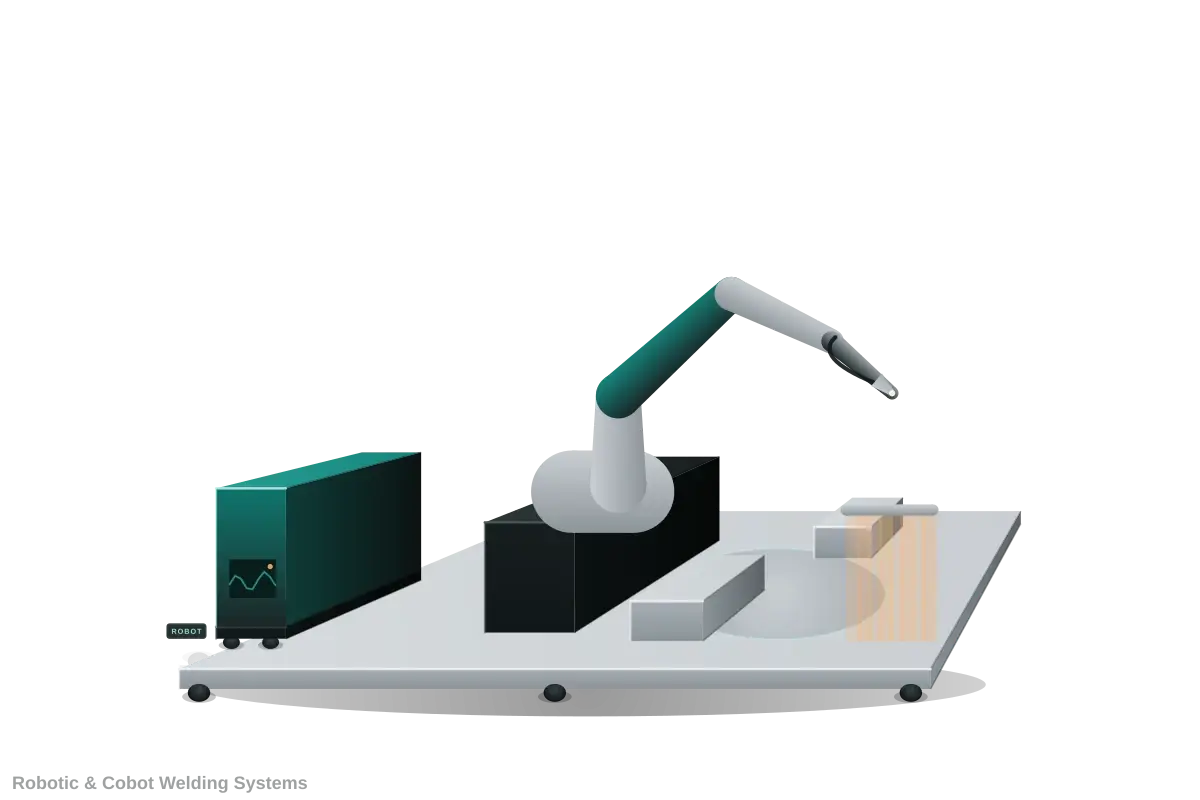
Cobot & Robotic Welding Systems
Cobot and industrial robotic welding systems, configured to your parts and volumes. Engineered and built in India, with installation and operator training.
Built to briefconfiguration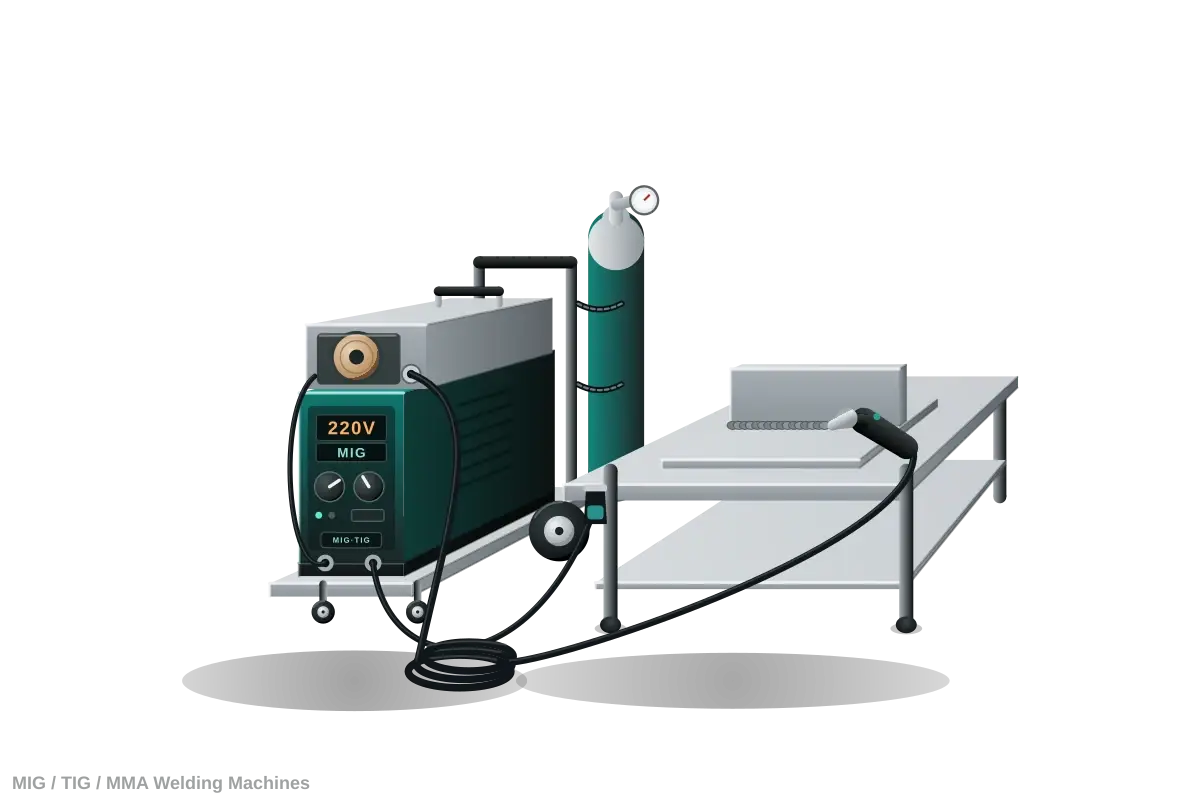
MIG, TIG & Arc (MMA) Welding Machines
MIG, TIG and MMA arc welding machines for 220 V and 440 V supply, customisable to your work. Engineered and built in India, with installation and training.
MIG · TIG · MMAprocesses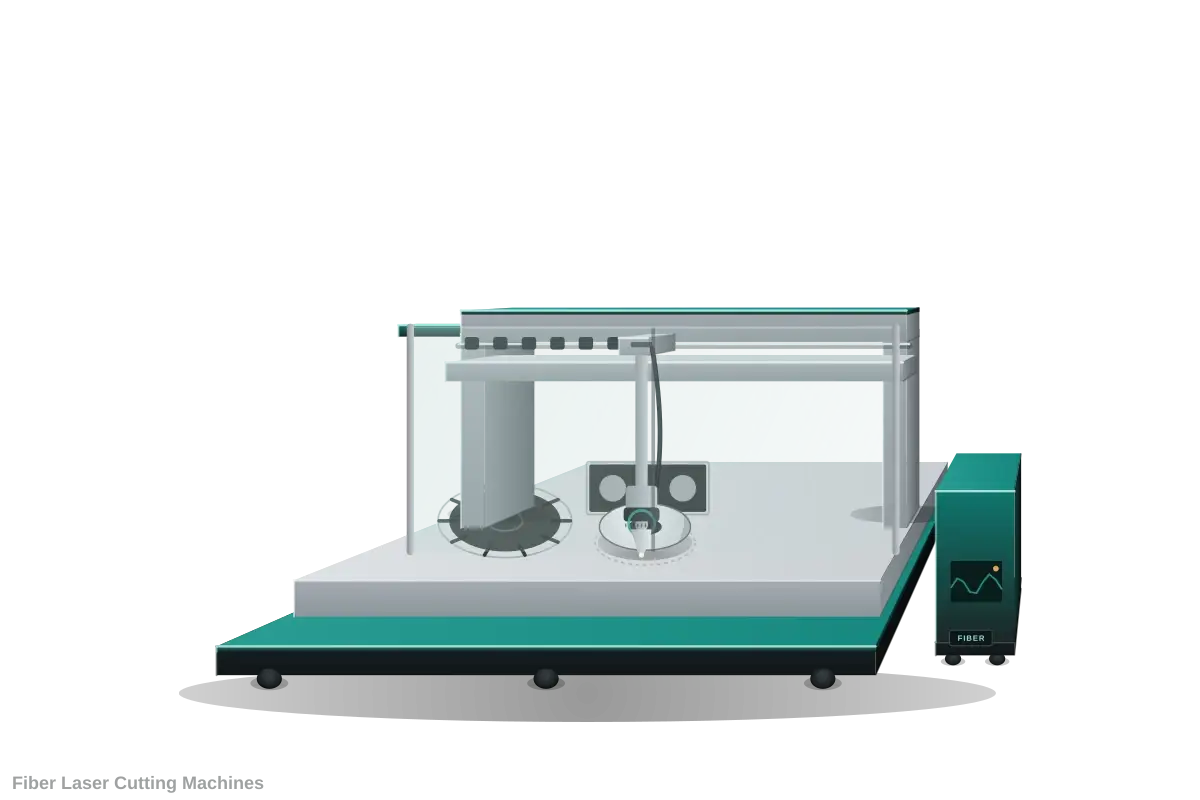
CNC Fiber Laser Cutting Machines
CNC fiber laser cutting machines from 1.5 kW to 30 kW, engineered and built in India for sheet and plate fabrication. Installation and training included.
1.5–30 kWlaser powerFAQ
Frequently asked questions
Can a cobot weld as well as an industrial robot?
For the weld itself, yes in most cases, because the quality comes mainly from the power source, wire feeder, parameters and steady torch control, which both provide. The difference is in speed between welds, payload and reach. An industrial robot completes more parts per shift on repeat work and handles larger assemblies, while a cobot is easier to teach and change over.
Does a welding cobot need a safety fence?
Not always, but it does need a risk assessment of the complete application. The cobot's force and speed limits reduce the danger of contact, yet the torch, sharp parts, arc light, spatter and fume remain. Screens against arc radiation and fume extraction are normally needed, and some applications still call for guarding or area scanners once the assessment is done.
What is the smallest batch size that justifies welding automation?
There is no single figure. What matters is how often the same parts come back, how long each part takes to weld by hand and how consistent your fitted parts are. A cobot can make sense for modest batches that repeat every few weeks, because changeover is quick. Truly one-off work is usually still better welded manually.
Will a welding robot replace my welders?
Usually it changes their work rather than removing it. Someone has to fit up parts, load fixtures, program new welds, check quality and handle the jobs that are too varied to automate. Many shops move an experienced welder into the programmer's role, combining their judgement of a good weld with the robot's consistency, while manual welders concentrate on one-off and repair work.
Can I start with a cobot and move to an industrial robot later?
Yes, and it is a sensible route for many shops. A cobot teaches the team how to prepare consistent parts, design fixtures and manage welding programs, and that knowledge carries straight over. Fixtures and welding parameters developed on the cobot can often guide the design of a later industrial cell when volumes grow enough to justify it.
Talk to an engineer
Tell us your material, thickness and production volume and we will recommend and quote the right configuration.