
Buyer guide
What Is Submerged Arc Welding (SAW) and When Should You Use It?
RA Machine · Updated
What is submerged arc welding?
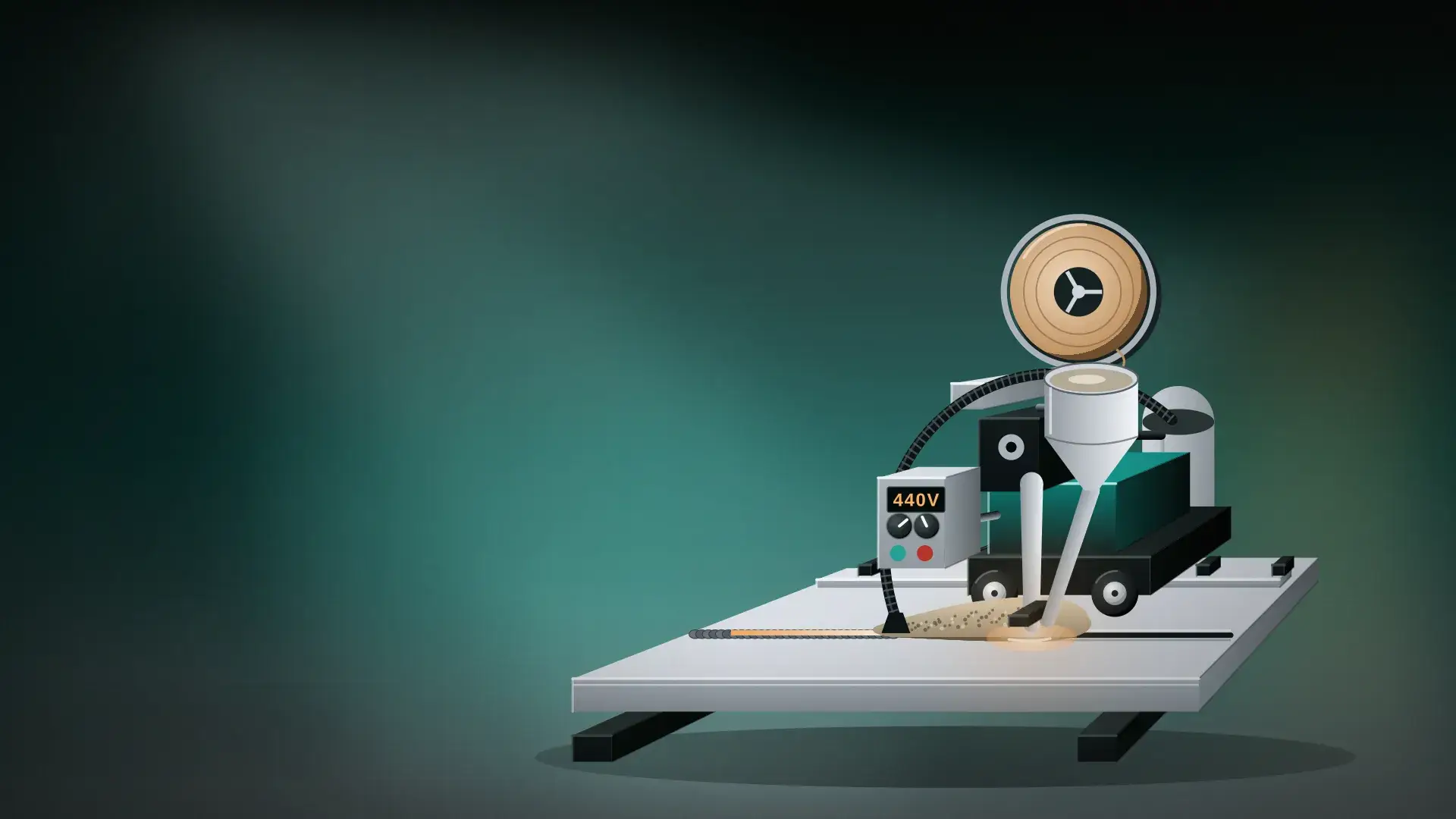
Submerged arc welding, usually shortened to SAW, is an arc welding process that is almost always run by a machine rather than held in the hand. A bare wire electrode feeds from a spool into the joint, and a layer of granular flux is poured over the joint just ahead of the wire. The arc burns underneath that flux, which is where the name comes from.
Because the arc is covered, you do not see the bright flash that comes with MIG, TIG or stick welding, and there is very little spatter or visible fume. What you see is a welding head moving steadily along the seam, a mound of flux, and behind it a crust of slag that peels away to reveal a smooth, even bead. It is the standard way to weld long seams on heavy fabrications such as pressure vessels, tanks, pipes and plate girders.
How does the SAW process work?
The power source drives a high current through the wire, which melts into the joint along with the edges of the parent plate. The flux does several jobs at once. The portion that melts forms a liquid layer and then a slag that shields the weld pool from the air and slows its cooling, giving the bead its smooth surface. Some fluxes also add alloying elements to the weld. The unmelted flux simply lies on top and is vacuumed or swept up, sieved and returned to the hopper for reuse.
Since a machine controls the wire feed, the voltage and the travel speed, the weld conditions stay the same from one end of a long seam to the other. That consistency is a large part of SAW's appeal. The operator's job shifts from holding a torch to setting up the joint, choosing parameters, watching the seam tracking and keeping the flux supply clean and dry.
What are the advantages and limitations of SAW?
SAW's strengths come from high current and mechanised travel. It deposits weld metal much faster than manual processes, penetrates deeply so thick joints need fewer passes, and gives a consistent bead with little cleaning afterwards. The covered arc makes the working environment more comfortable, with no need for the operator to watch an open arc for hours.
The limitations are just as clear, and they are why SAW sits alongside other processes rather than replacing them.
- Position: the flux must lie on the joint, so SAW is limited to flat welds and horizontal fillets
- Setup: it needs travel equipment and fixtures, so it does not pay on short or one-off welds
- Material thickness: it is suited to medium and heavy plate, not thin sheet, where the heat input is too high
- Fit-up: joints must be clean, well prepared and consistently aligned, because the machine will not compensate for poor fit-up the way a welder can
- Visibility: the operator cannot see the arc, so accurate seam tracking and setup matter
When should you choose SAW over MIG or manual welding?
The decision usually comes down to seam length, plate thickness, position and how often the job repeats. A shop that welds a few long seams a month may manage with MIG. A shop that welds them every day will usually find SAW pays back in time, consumables per metre and quality.
- Choose SAW for long longitudinal or circumferential seams on thick plate that can be turned to the flat position
- Choose SAW when the same heavy weld is repeated across many jobs, such as shells, beams or pipe sections
- Choose SAW for hardfacing and building up worn rollers and shafts, where large deposits are needed
- Choose MIG for shorter welds, complex shapes, thinner material and production fabrication
- Choose MMA or TIG for positional welding, site work and root passes
What makes up a complete SAW setup?
A SAW machine is better thought of as a system than a single box. At its heart are the power source and the welding head, which holds the wire feeder, the contact tip and the flux delivery. Around that sits the equipment that moves either the head or the job, and that equipment depends on the shape of your work.
For straight seams on plates and beams, a welding tractor running along the joint, or a column-and-boom manipulator carrying the head, provides the travel. For circumferential seams on shells and pipes, the head usually stays still while rotators or a positioner turn the job beneath it. A flux recovery unit, wire spool stands, fixtures and seam tracking complete the arrangement. Sizing all of this to your largest and heaviest job, not just your average one, avoids expensive changes later.
Wire, flux and joint preparation
SAW is most often used on carbon and low-alloy steels, and it also welds stainless steel with matching consumables. The wire and flux are chosen as a pair, because together they determine the chemistry, strength and toughness of the weld. Fabricators working to a code or a client specification will normally qualify a welding procedure with a particular wire and flux combination and then stick to it.
Flux must be stored dry. Damp flux is a common cause of porosity and, on hardenable steels, of hydrogen cracking, so many shops keep opened flux in heated storage and follow the flux maker's guidance on drying. Joint preparation matters just as much: clean, consistently bevelled and well-aligned joints are what let a SAW machine run at its best.
How RA Machine supplies SAW machines
RA Machine builds submerged arc welding machines for 440 V three-phase supply, customised to the buyer's seams, job sizes and handling equipment. We start from your drawings and production plans, then propose the power source, head and travel arrangement that suits them. If you are outside India, tell us your local supply voltage and frequency at the enquiry stage so the machine is configured to it.
Installation, commissioning and operator training are included, covering parameter setting, flux handling and safe operation. Lead time is typically 8 to 10 weeks. After handover we provide remote diagnostics within four working hours, on-site service the next working day around Kolkata and within 48 hours elsewhere in India, stocked spares and a 12-month warranty, with customised extended warranty on request.
Our range
Machines for this job
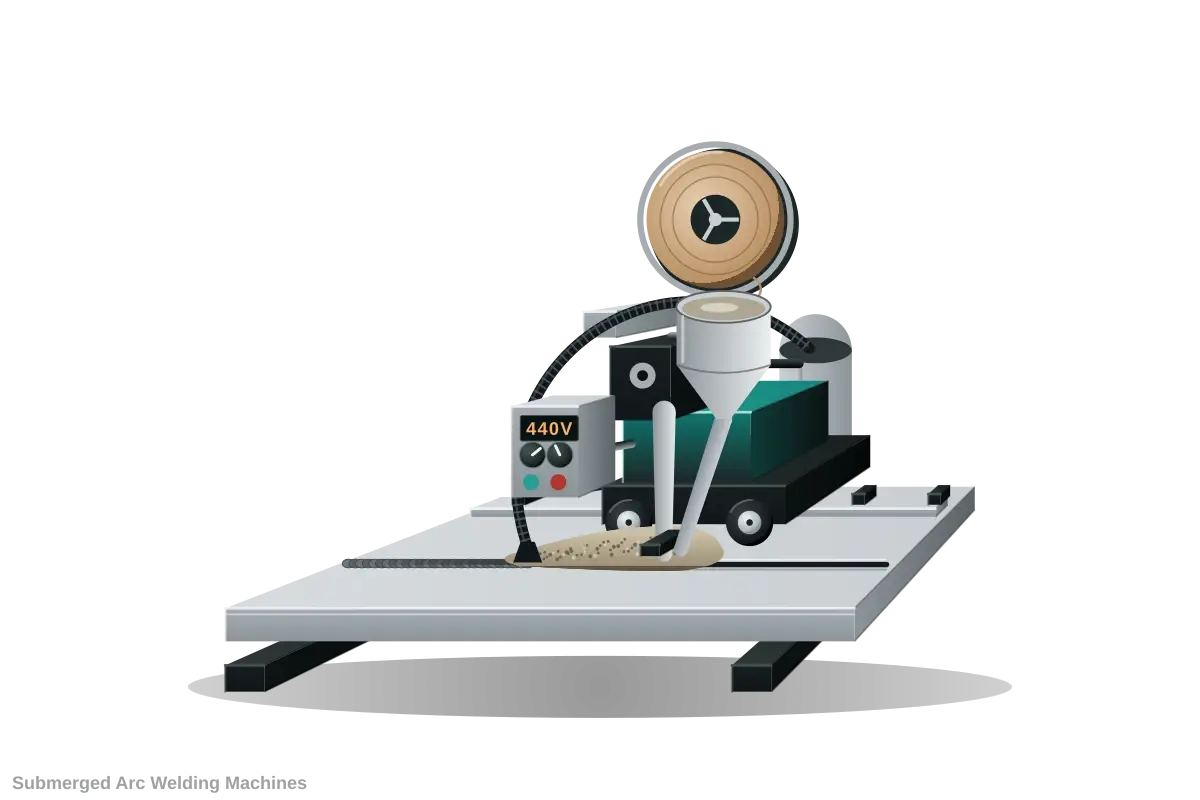
Submerged Arc Welding (SAW) Machines
Submerged arc welding (SAW) machines for 440 V, customisable for long seams on thick plate. Engineered and built in India, with installation and training.
440 Vsupply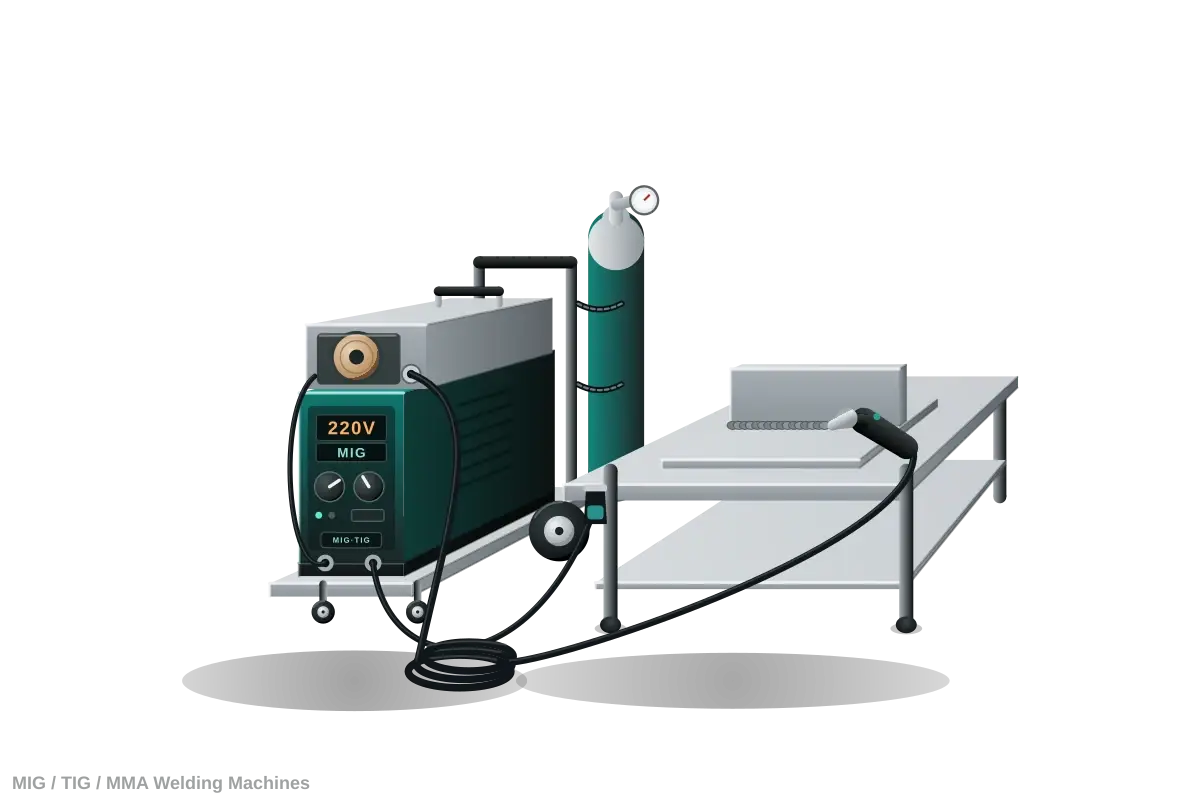
MIG, TIG & Arc (MMA) Welding Machines
MIG, TIG and MMA arc welding machines for 220 V and 440 V supply, customisable to your work. Engineered and built in India, with installation and training.
MIG · TIG · MMAprocessesFAQ
Frequently asked questions
Why is it called submerged arc welding?
Because the arc burns beneath a layer of granular flux rather than in the open air. The flux is poured over the joint just ahead of the wire, so the arc is buried or submerged under it throughout the weld. That covering hides the arc flash, shields the molten metal from the atmosphere and leaves a slag crust that protects the bead as it cools.
Can submerged arc welding be done by hand?
Semi-automatic SAW guns, carried along the seam by a welder, do exist, but they are uncommon today. In practice almost all SAW is mechanised or fully automatic, with a tractor, column-and-boom or fixed head providing steady travel. The process relies on constant speed and a steady flux supply over long seams, which a machine does far more consistently than a person.
Is SAW suitable for thin sheet metal?
Generally no. SAW puts a lot of heat into the joint, which is an advantage on thick plate but tends to cause burn-through and distortion on thin sheet. It is best suited to medium and heavy plate. For thin material, MIG, TIG or laser welding give better control. If your work spans a wide range of thicknesses, most shops pair SAW with MIG.
Does SAW produce fumes and arc glare?
Far less than open arc processes. The flux covers the arc, so there is no bright flash and very little visible fume or spatter, which makes conditions around the machine more comfortable. Some fume and dust still come from the flux and slag, so normal workshop ventilation, flux handling care and protective equipment for slag removal remain sensible.
What causes porosity in submerged arc welds?
The usual culprits are moisture, contamination and shielding problems. Damp flux, rust, oil, paint or primer on the joint, and too thin a layer of flux over the arc can all trap gas in the weld. Keeping flux dry, cleaning the joint area before welding and maintaining a steady flux depth are the most effective ways to prevent it.
Talk to an engineer
Tell us your material, thickness and production volume and we will recommend and quote the right configuration.